Start here
braids reads the transcripts Claude Code already writes and draws them as a graph you can search, branch and prune. It never talks to a model.
What it is
Claude Code keeps one conversation per session, in one JSONL file under
~/.claude/projects. That works while a session stays on one
thread. Real work does not: you fork to try something, double back, spawn
three side quests, and a week later you have thirty session files with no
shape between them.
braids gives them a shape. It does four things.
- Draws the graph. Every conversation, with branches under the conversation they were cut from.
- Searches all of it. Messages, tool calls, project memories, and the names of files a session left on disk.
- Branches anywhere. Put the cursor on a turn, get a new conversation that starts there.
- Shows the mess. Scratch files, memories the index has lost track of, subagents you never saw.
braids does not call a model, and it does not need an API key. It arranges the conversations you have with one. See Files and privacy for how to check that claim yourself.
Install
# picks the build for your machine and checks it against the published sums
curl -fsSL https://braids.chat/install.sh | sh

# or with Go
go install github.com/Ashes47/braids/cmd/braids@latest

# or from source
git clone https://github.com/Ashes47/braids && cd braids
make install
The installer puts one binary in /usr/local/bin when that is
writable, and ~/.local/bin otherwise. Set
BRAIDS_BIN_DIR to choose, or BRAIDS_VERSION to pin
a version.
Uninstalling
braids hooks --remove    # take the hook back out of ~/.claude/settings.json
rm "$(command -v braids)"
rm -rf ~/.braids         # the index and its sidecar files
Your conversations live in ~/.claude and are never touched, so
removing braids costs you the map and nothing else.
Windows
There are Windows builds, as a zip on the
releases page: unzip
it and put braids.exe somewhere on your PATH. There is no
one-line installer, because the one braids has is a POSIX shell script and it
will not ship a PowerShell one it has never run.
Everything reads and searches the same. Two things are not offered rather
than offered broken: o does not open a terminal through
BRAIDS_SPAWN, because that template runs through a shell and
quoting it for cmd.exe is a different set of rules that braids
cannot test, and v does not update, because there is no installer
to run. Both fall back to copying, which is what braids already does for any
terminal it cannot drive. The tests run on Windows in CI.
Staying current
Run the same line again to update. It asks the binary it would replace what
version it is and stops if there is nothing to do, and it replaces braids
where it already lives, so a build installed with Go is not shadowed by a
second copy in /usr/local/bin.
braids cannot tell you that a newer version exists, because finding out means
asking and braids makes no network calls. It can say how long it has been
since anyone checked, which it reads from two local facts: when this binary
arrived, and when the installer last ran. After a month the map's version row
grows · 3 months old · v to update, and v runs the
installer, printing the command before it does. Checking and finding yourself
current resets the clock, so it asks at most once a month and never claims
you are behind.
The first index
braids index
This reads every transcript under ~/.claude/projects and writes
one SQLite file to ~/.braids/index.db. On a corpus of 28
conversations and about 360 MB of transcripts it takes about eight seconds.
Every run after that reads only what changed, which is single-digit
milliseconds, and the map re-indexes on its own while it is open.
Nothing else creates the index. A read command pointed at a database that is not there says so rather than making an empty one and answering no matches, which is a wrong answer wearing the shape of a right one.
braids search anything --db /nope/absent.db
# braids: no index at /nope/absent.db (run: braids index)
Five minutes in
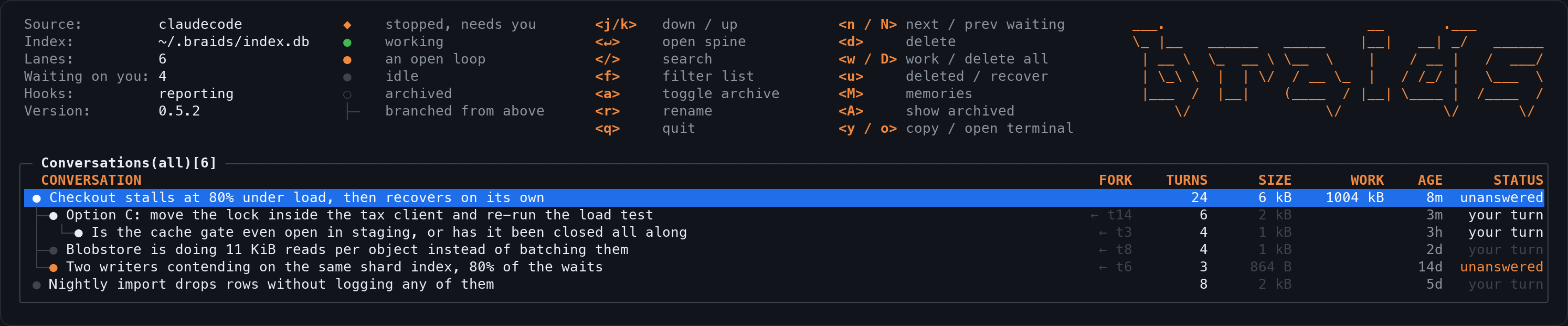
Then, in order of how often you will want them:
| Key | What it does |
|---|---|
| ↵ | open the conversation under the cursor, turn by turn |
| / | search everything, from any screen |
| n | jump to the next conversation waiting on you |
| w | what this session wrote to disk, heaviest first |
| M | what this project remembers |
| y | copy the claude --resume command for this conversation |
| q | quit |
Nothing here is a command you have to memorise. The header of every screen lists every key that screen takes, and the glyph key next to it names every mark on the screen.
Everything else
Nine more pages, in the order they make sense in.
Where things live
| Path | What it is | Who owns it |
|---|---|---|
| ~/.claude/projects | your transcripts, one file per session | Claude Code |
| ~/.claude/projects/<p>/memory | what a project remembers | Claude Code |
| ~/.claude/jobs | the scratch files a session wrote | Claude Code |
| ~/.braids/index.db | the search index, mode 0600 | braids |
| ~/.braids/*.json | names, archive flags, fork origins | braids |
| ~/.braids/bin | what braids has deleted, for 14 days | braids |